World premiere: 27 September 2026 - Reggio Emilia, Teatro Ariosto | Festival Aperto
FAUN
Choreography: Sidi Larbi Cherkaoui
Restaged by: Daisy Phillips
Music: Claude Debussy, Prélude à l’après-midi d’un faune; Nitin Sawhney
Lighting Design and Set Design: Adam Carrée
Costumes: Hussein Chalayan
Costume Realization: Nuvia Valestri
Performers: Aurora Lattanzi, Giuseppe Villarosa
Duration: 15 minutes
World Premiere: London, Sadler’s Wells, 13 October 2009
First Performance by MM Contemporary Dance Company: Reggio Emilia, Teatro Ariosto – Festival Aperto, 27 September 2026
Faun is a work created in 2009, commissioned by Sadler's Wells Theatre in London from Sidi Larbi Cherkaoui as part of the celebrations marking the centenary of the Ballets Russes. This work, of rare beauty and intensity, is presented here as performed by two dancers of MM Contemporary Dance Company.
The choreographer chose to offer his own personal interpretation of Nijinsky's legendary choreography L'Après-midi d'un faune, inspired by Stéphane Mallarmé's poem and danced to the Impressionist music of Claude Debussy. Nijinsky's version drew inspiration from the pastoral scenes of the Iliad and ancient Greece to create a work centred on the love between a faun and a nymph. It was highly two-dimensional, very classical, yet also bold, sensual, and rather controversial for its time.
Cherkaoui sought instead to focus more closely on the fact that the faun is half animal and half man. His movements are wilder, more visceral, and more carefree. The female dancer enters the stage as a nymph, deeply rooted in the forest. The interaction between the faun and the nymph on stage is innocent, yet permeated by the sexual tension of Nijinsky's original choreography; they are playful like children, yet also archaic like ancient souls. The two dancers on stage become timeless archetypes as much as creatures of the present.
To make the music more surprising and contemporary, less tied to a specific cultural and historical context, Cherkaoui asked composer Nitin Sawhney to interrupt Debussy's composition by introducing fragments of his own music, allowing it to slip almost imperceptibly from one style and one culture to another, from one century to another.
Hussein Chalayan designed the costumes for these two creatures, developing something that appears natural and organic while at the same time synthetic. The dancers thus become timeless archetypes as much as creatures of the present.
THE DYING SWAN
New choreography created exclusively for MMCDC
Choreography: Sidi Larbi Cherkaoui
Music: Camille Saint-Saëns, The Swan; Alexandre Dai Castaing
Choreographic Assistant: Mason Kelly
Lighting Design: Gessica Germini
Costumes: Veerle Van den Wouwer, Sidi Larbi Cherkaoui
Costume Realization: Nuvia Valestri
Performers: Mario Genovese, Paolo Giovanni Grosso, Giorgia Raffetto, Nicola Stasi
Duration: 15 minutes
World Premiere: Reggio Emilia, Teatro Ariosto – Festival Aperto, 27 September 2026
With his unmistakable choreographic sensitivity and fluid movement language, Sidi Larbi Cherkaoui gives new life to Mikhail Fokine's celebrated choreography The Dying Swan. In this new production created for MM Contemporary Dance Company, the choreographer reinterprets the original work, transforming it into an intense quartet: three creatures – are they vultures, crows, or angelic figures? – accompany and lift a woman – or is she a swan? – along a journey that becomes a metaphor for spiritual ascent, leading her towards a dimension suspended between life and death. This is not simply a contemporary restaging, but a profound exploration of the final breath, of grace in suffering, and of the beauty that endures even in the last moment of life.
The setting is bare, almost dreamlike, and the choreography is enveloped in an ethereal intensity. The movements, perfectly in keeping with Cherkaoui's style, unfold through a continuous undulation of the back and the arms, which are no longer merely the wings of a swan, but metaphors for fragility and resilience.
The Dying Swan thus becomes a choreography that transcends classical narrative in order to focus on pure emotion. The female figure on stage is not simply a dying creature, but the embodiment of a vulnerable beauty confronting the future and the unknown. The work takes shape as a hymn to the resilience of the human spirit and an invitation to recognize beauty even in the most painful and fleeting moments.
ATTO BIANCO
Choreography: Enrico Morelli
Music: Pyotr Ilyich Tchaikovsky; Giuseppe Villarosa
Narrator: Jacopo Trebbi
Lighting Design: Gessica Germini
Costumes: Enrico Morelli, Nuvia Valestri
Performers: Filippo Begnozzi, Elisa Bocconi, Mario Genovese, Paolo Giovanni Grosso, Aurora Lattanzi, Federico Musumeci, Giorgia Raffetto, Alice Ruspaggiari, Diletta Savini, Nicola Stasi, Giuseppe Villarosa
Duration: 30 minutes
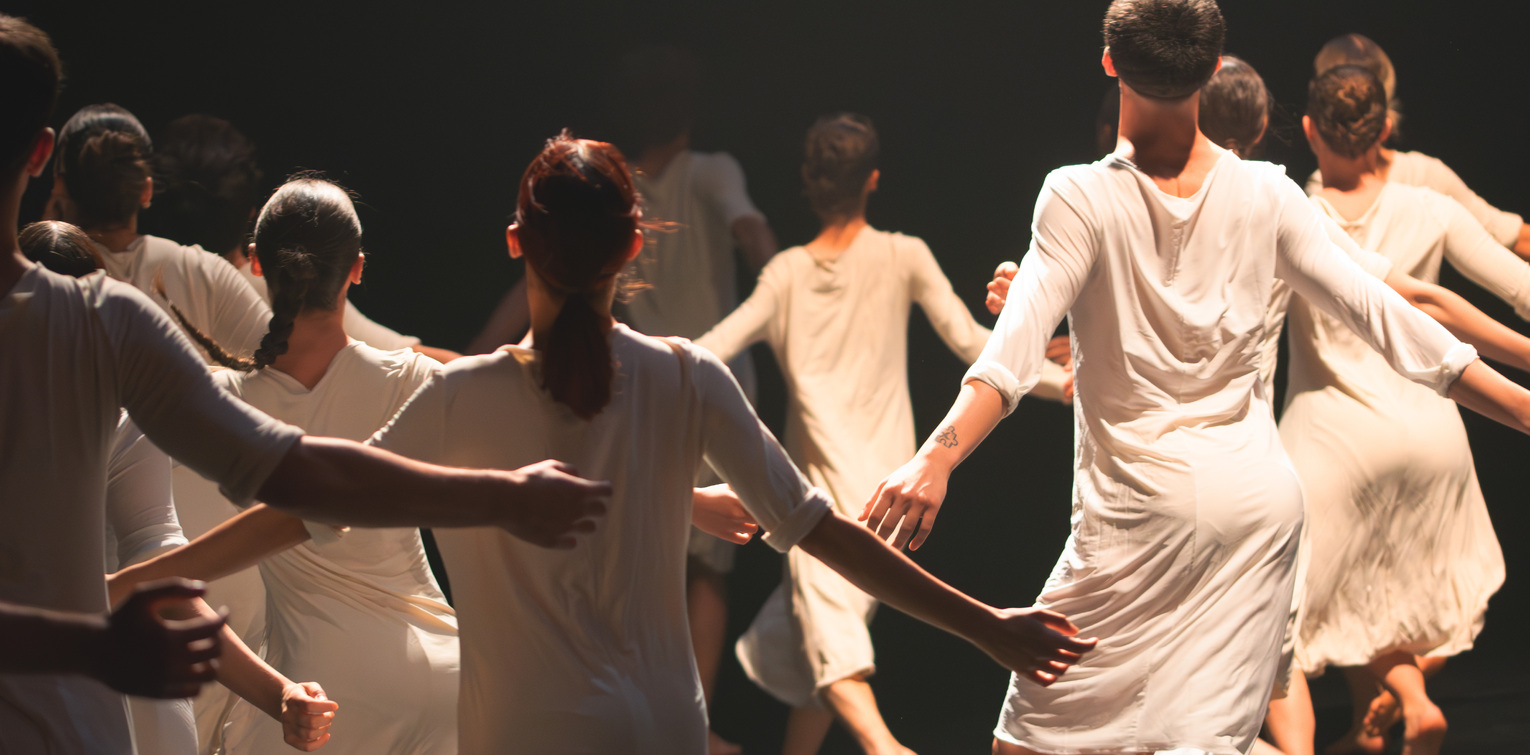
Enrico Morelli's new work for MM Contemporary Dance Company is not intended as a mere reinterpretation of the "white act" from Swan Lake, but as a bold and contemporary exploration of its foundations. Morelli draws upon the knowledge and choreographic patterns of the classical repertoire, translating them into a new language in which "white" ceases to be an aesthetic canon and becomes instead a symbol of truce and resilience.
The result is a choreography that reinterprets the original suggestions through new geometries and fluidity of movement, involving the entire company in a collective and textured choreographic design. In Atto Bianco, Tchaikovsky's score enters into dialogue with the electronic compositions of Giuseppe Villarosa, giving rise to a soundscape in which the harmony of the classical score confronts the tensions of the present. Through movements that unfold with elegance and precision, the creation captures the essence of the music while exploring the fragility of the human condition in the face of conflict. With this production, Morelli confirms his reputation as a choreographer capable of combining profound musicality with an established compositional talent, offering a new and original vision that invites the audience to reflect on beauty as an act of resistance.
Production MM Contemporary Dance Company
Co-production Fondazione I Teatri Reggio Emilia, Eastman